It’s well-known that the period of a simple harmonic oscillator (SHO) is independent of its oscillation amplitude. But is this the only oscillator for which this holds?
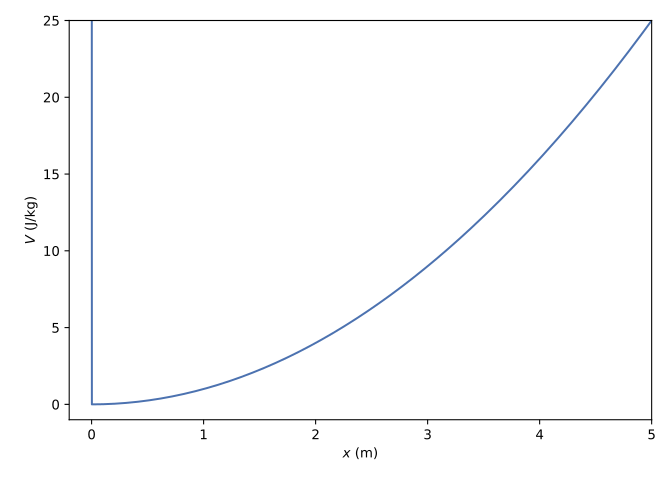
No. A simple counterexample is the SHO + ‘brick wall’ potential:
A bit silly, you might say. What if we restrict ourselves to symmetric (even) potential functions?
As intuition suggests, it turns out that the SHO is indeed the unique symmetric constant-period oscillator. We will denote the potential by U(x), and make the following assumptions:
As discussed, we assume U(x)=U(−x).
For simplicity, we set U(0)=0.
Since we are doing physics, we assume that U(x) is differentiable.
To avoid the particle getting stuck, we will assume that U(x) is strictly increasing on x>0.[1]
In what follows, we assume x>0. Suppose we launch the particle rightwards at time t=0 with kinetic energy E. By time-symmetry, the particle must come to rest at time t=T/4, where T is the period of the oscillator. ThusT=4∫0T/4dt=4∫0EdxdtdUdxdU=4∫0EvU′(x)dU,where v is the velocity of the particle. Since E−U=21mv2 is the kinetic energy of the particle, we haveT∝∫0EU′(U)E−UdU=∫0EUE−U1:=f(U)U′(U)UdU.Making the substitution U=Esin2θ, we obtainT∝∫0π/2f(Esin2θ)dθ.The proportionality constant throughout depends only on m and fixed numerical factors. If the oscillator is to have a fixed period, the integral∫0π/2f(Esin2θ)dθmust be independent of E. Under some mild continuity assumptions, it is a fun analysis exercise to show that f must be constant.[2]But integrating the equalityUdU=UU′dx=f(U)dx=Cdxyields 2U=Cx,[3]the harmonic oscillator potential.
Footnotes
[1]This condition implies that U is a parameterization of x for x>0. We will frequently omit pullbacks and write f(U) instead of f(x(U)).↩
[2]This makes intuitive sense; the integral is essentially a weighted average of f on the interval [0,E]. For all such averages to be equal, the function f must be constant.↩